For Parents and Caregivers
What to Expect
At Seabird, parents and caregivers are seen as essential partners in a child’s therapeutic journey. When caregivers feel supported, informed, and confident, children feel safer to explore, express, and grow. Your involvement, stability, and attunement form the foundation of healing.
The Parent Intake Session
Therapy begins with a 90-minute Parent Intake Session (without your child present).
This is a chance to:
share your child’s story, developmental history, strengths, and challenges
explore goals and hopes for therapy
discuss family patterns, school needs, and current stressors
understand how play therapy works and what to expect over the coming weeks
Together, we create a clear picture of your child’s needs and select the most appropriate therapeutic approach.
The Therapy Structure
Children attend weekly 45-minute sessions, held at the same time each week. Consistency and predictability strengthen safety and therapeutic progress.
After 10 individual sessions, parents are invited to a Review Meeting to discuss:
emerging themes in therapy
your child’s progress
ways to support emotional growth at home
Review meetings continue every 10 sessions to ensure we are working together as a connected team.
Play therapy is a gradual, relational process. Children move at their own pace, sometimes revisiting earlier themes as safety deepens and their nervous system reorganises.
Your Role as a Parent/Carer
While the playroom belongs to your child, the container around it is held by you. You support therapy by:
keeping therapy days calm and predictable
avoiding detailed questions about the session to honour your child’s privacy
observing changes in mood, behaviour, or transitions and sharing them with your therapist
using reflective listening and empathy at home
attending parent review meetings to stay connected to the process
Your steady presence helps your child feel internally safe and ready for change.
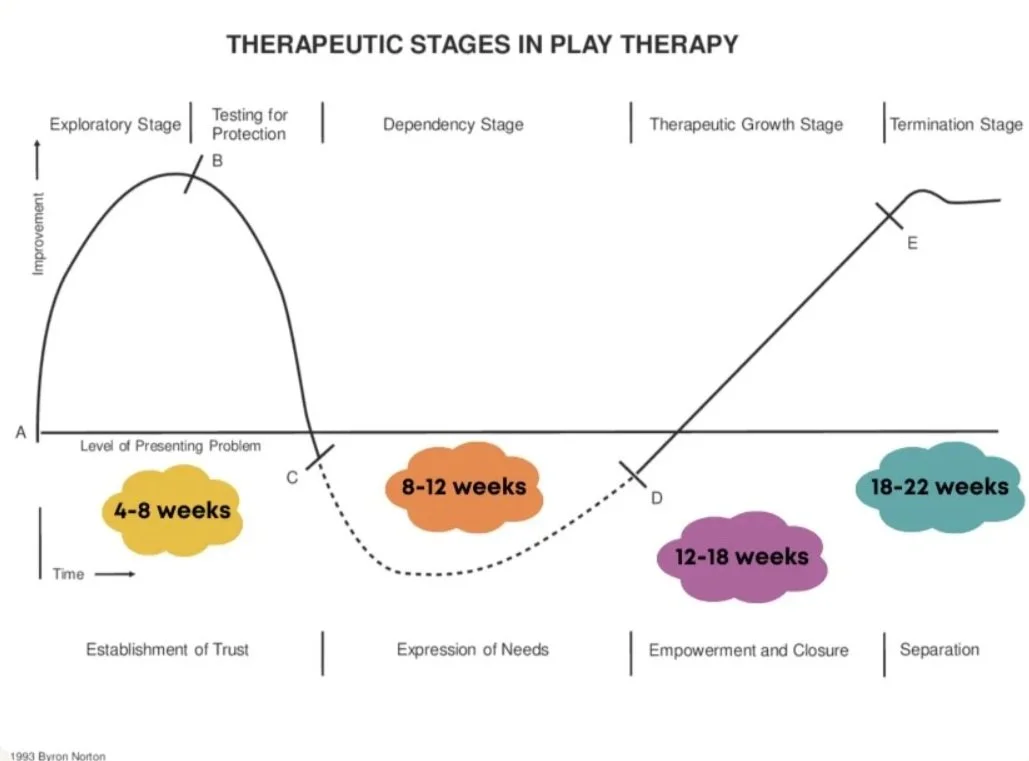
The Four Stages of Play Therapy
Every child’s process is unique, but most move through four broad stages.
1. Establishing Trust (Initiation / Exploratory Phase)
The first 4–6 sessions focus on building safety, familiarity, and connection. Children:
learn what to expect in the playroom
explore the toys and environment
test limits to understand the boundaries and roles
develop a trusting relationship with their therapist
Some children settle instantly; others approach slowly and cautiously. Both are normal.
During this time, caregivers often notice early shifts—reduced tension, increased openness, or excitement about attending therapy. These sessions create the essential foundation for all therapeutic work.
2. Exploration & Expression (Resistance / Testing-for-Protection Phase)
Once children feel safe, deeper emotional material begins to surface. This stage is often misunderstood as “regression,” but it is actually a sign of therapeutic progress.
Children may:
revisit old behaviours
express big emotions
show increased sensitivity
experience fatigue
resist attending therapy or test boundaries more intensely
This is the nervous system reorganising and the child preparing to face internal struggles. They are checking:
“Can you hold me steady when my feelings get big?”
Parents support this stage by:
staying calm and consistent
validating feelings
maintaining routines
reminding their child of their capabilities
This phase can last a few sessions or a few months depending on the child’s history, temperament, and support system.
3. Empowerment & Growth (Working Phase)
In this stage, children begin integrating new skills and moving toward increased resilience. You may notice:
improved emotional regulation
increased independence and confidence
clearer communication of needs
more flexible thinking and problem-solving
healthier ways of relating and playing
Children begin to use coping skills with less prompting and show a greater capacity to repair after difficult moments. Sometimes old patterns reappear briefly — this is not failure, but the brain strengthening new neural pathways.
Parents support growth by remaining steady, empathic, and consistent with expectations.
4. Separation & Consolidation (Termination Phase)
When children are consistently demonstrating new skills across home, school, and social environments, we begin preparing for the end of therapy.
This is a thoughtful, gradual process that includes:
reducing session frequency
reinforcing independence
revisiting themes to consolidate learning
reflecting on the therapeutic journey
celebrating the child’s strengths and achievements
Children sometimes feel unsure or sad during this time, as the therapeutic relationship has been a safe and consistent place. Caregivers help by validating feelings, maintaining routines, and reminding the child of the skills they now hold within themselves.
Some small regressions after ending therapy are normal; the foundation remains strong. You are always welcome to reconnect if new concerns arise.
Supporting the Whole Family
Therapy at Seabird is relational at its core. Parents are offered support to:
understand family dynamics
strengthen co-regulation
recognise intergenerational patterns
create a home environment that fosters emotional safety
When caregivers grow alongside their child, the entire family system shifts toward wellbeing.
Ready to Connect?